From Centers to Solutions: Unpacking Alzheimer’s Care in the Lone Star State
Understanding Alzheimer’s Care: Insights for Michigan Families
Alzheimer’s care requires specialized support designed to meet the needs of the millions of Americans living with Alzheimer’s disease and the family members caring for them. In Michigan, over 190,000 residents are living with Alzheimer’s, and hundreds of thousands of family members provide unpaid care.
At Memory Lane, we operate specialized memory care assisted living communities in Ann Arbor, Ypsilanti, and Saline, Michigan, providing 24/7 personalized, compassionate support for individuals with dementia and Alzheimer’s. This guide focuses on what high-quality memory care should look like and how Michigan families can find the right support for their loved ones.
Quick Guide to Memory Care Options:
- Assisted Living with Memory Support – Residential care with specialized dementia training
- Memory Care Facilities – Secure, specialized environments with 24/7 trained staff for dementia care
- State Resources – Every state offers local referral services through Area Agencies on Aging and similar programs
The numbers tell a sobering story nationwide. Alzheimer’s disease affects millions of Americans, and Michigan is no exception, with over 190,000 diagnosed residents and many more undiagnosed. The challenges are the same everywhere: watching someone you love struggle with memory loss, confusion, and the gradual loss of independence.
If you’re reading this, you’re likely seeing changes in someone you love. Maybe it’s your parent forgetting familiar routes home, your spouse struggling to follow conversations, or your partner becoming withdrawn and anxious. These moments are frightening, and the path forward can feel overwhelming.
Alzheimer’s disease slowly destroys memory, thinking ability, and eventually the capacity to carry out simple daily tasks. It accounts for up to 80% of all dementia cases. But here’s what’s important to know: you don’t have to steer this alone. Every state offers care options, resources, and support organizations designed to help families facing these challenges, and specialized memory care communities like Memory Lane exist to provide expert, compassionate care for residents in our Michigan locations.
The good news? Research shows that 45% of dementia cases can be prevented through lifestyle changes. Early detection matters. The right support makes a difference. And understanding your options is the first step toward finding the care your loved one needs.
I’m Jason Setsuda, a Board Certified Emergency Medicine Physician with over 10 years of medical experience and 5 years as a Medical Director, currently serving as CFO of Memory Lane Assisted Living with premier locations in Ann Arbor, Ypsilanti, and Saline, Michigan, and Medical Director for multiple healthcare organizations in Metro Detroit. Our mission at Memory Lane is to provide the highest standard of memory care, and the guidance in this article is meant to help families understand their Alzheimer’s care options and what to look for in quality support.
Key Alzheimer’s care topics to explore:
Understanding the Impact and Early Signs of Alzheimer’s

At Memory Lane, our team provides specialized memory care in Ann Arbor, Ypsilanti, and Saline, Michigan, and we work with families who are navigating an Alzheimer’s diagnosis. The prevalence of Alzheimer’s is a significant public health concern nationwide, and Michigan families face the same challenges as those in every other state.
In Michigan, over 190,000 residents are currently diagnosed with Alzheimer’s, with the ripple effect touching hundreds of thousands of caregiving family members. Behind every diagnosis is a network of family and friends who provide the essential daily support required to manage this condition.
Understanding the timeline of this disease is crucial for families. Experts note that amyloid-beta plaques, the hallmarks of Alzheimer’s, can begin developing in the brain years or even decades before the first outward symptoms appear. This is why being proactive about Diagnosis Information is so vital for every family.
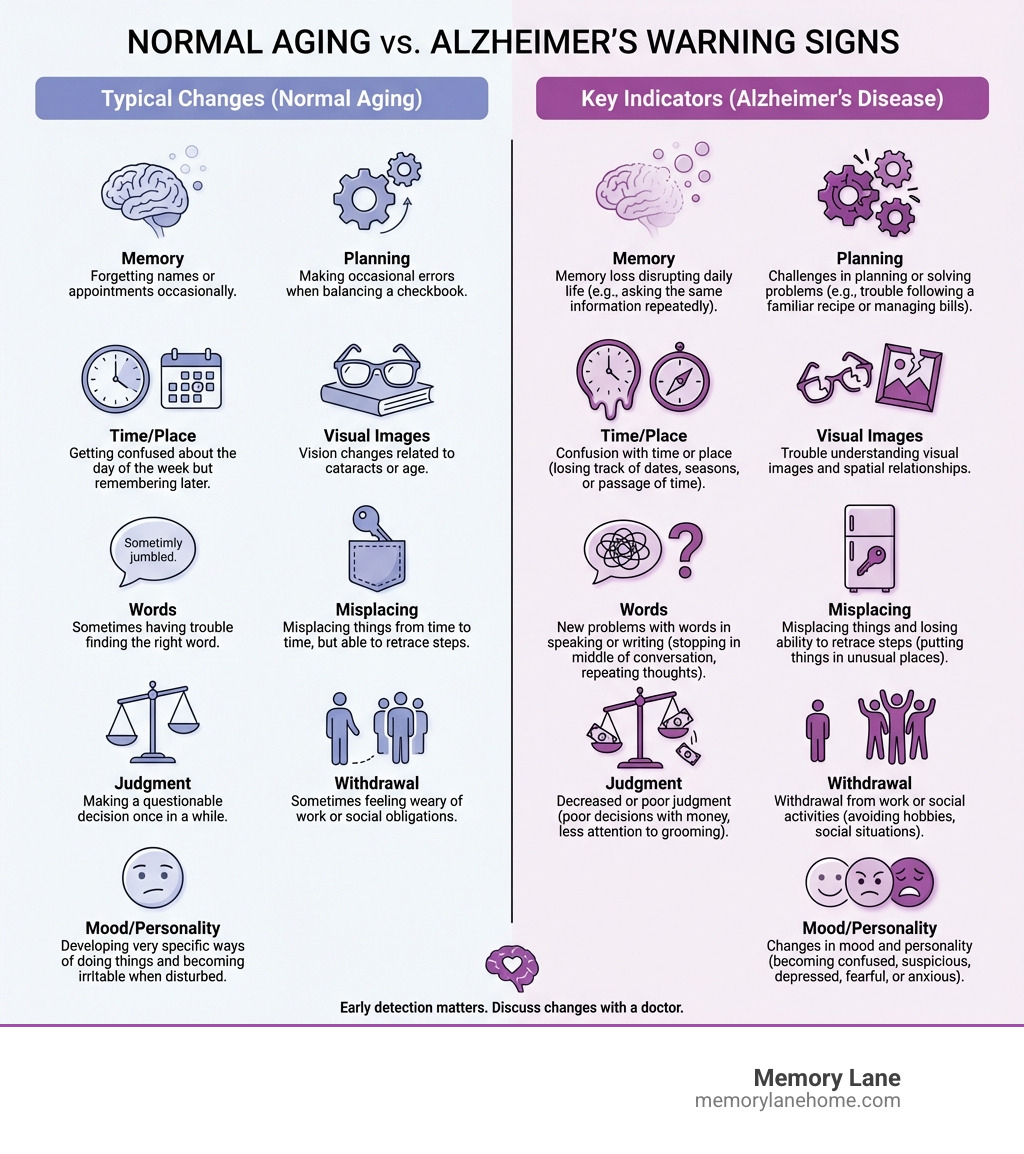
Recognizing the 10 Early Warning Signs
Early detection provides the best opportunity for treatment, clinical trial participation, and future planning. We encourage families to look for these ten warning signs:
- Memory loss that disrupts daily life: Forgetting recently learned information or important dates.
- Challenges in planning or solving problems: Struggling to follow a familiar recipe or keep track of monthly bills.
- Difficulty completing familiar tasks: Trouble driving to a familiar grocery store or remembering the rules of a favorite game.
- Confusion with time or place: Losing track of dates, seasons, or the passage of time.
- Trouble understanding visual images and spatial relationships: Difficulty with balance or reading, which may lead to issues with driving.
- New problems with words in speaking or writing: Struggling to join a conversation or calling things by the wrong name.
- Misplacing things and losing the ability to retrace steps: Putting items in unusual places and being unable to find them.
- Decreased or poor judgment: Experiencing changes in decision-making, such as mishandling money.
- Withdrawal from work or social activities: Scaling back on hobbies, social engagements, or other projects.
- Changes in mood and personality: Becoming confused, suspicious, depressed, fearful, or anxious.
Seeking a Diagnosis
If you notice these signs, the first step is a visit to a primary care physician, who can provide a referral to a neurological specialist. Michigan is home to excellent diagnostic resources, including the University of Michigan and other leading medical centers. Seeking a formal diagnosis allows families to access specialized Alzheimer’s care programs and begin building a support team. For those looking for more in-depth education, you can View the full “All About ALZ” presentation series on our YouTube channel to learn about coping strategies and medical management.
Navigating Alzheimer’s Care: Choosing the Right Memory Care Environment
When a loved one requires more help than a family can provide alone, specialized residential care becomes the primary solution for safety and quality of life. At Memory Lane, we serve families in Ann Arbor, Ypsilanti, and Saline, Michigan, and we help families understand the decision points that matter most when evaluating any memory care provider.
As the disease progresses, many families find that the safety and specialized engagement of a residential facility become necessary. Understanding The Role of Memory Care in Alzheimer’s Support is essential for making an informed transition.
| Feature | Standard Assisted Living | Specialized Memory Care (Memory Lane) |
|---|---|---|
| Focus | General senior support | Dementia & Alzheimer’s expertise |
| Safety | Standard security | Enhanced security (delayed egress) |
| Staffing | General caregivers | Specialized dementia training |
| Activities | Broad social events | Cognitive & sensory-based programming |
| Environment | Residential | Secure & navigation-friendly design |
Specialized Memory Care and Advanced Support
For those in the middle to late stages of dementia, specialized memory care provides a secure environment designed to reduce wandering and agitation. At Memory Lane, we use a “person-centered” approach, focusing on the individual’s remaining abilities rather than what has been lost. This philosophy is a widely used best practice in memory care.
Quality memory care facilities often provide tiered programs, including options specifically for advanced dementia that focus on sensory stimulation and high-touch care. Coordination with palliative care is also a key component of comprehensive Alzheimer’s care, ensuring comfort and dignity in the final stages of life. Families often find comfort in Understanding the Emotional Journey of Dementia Patients during these transitions.
Financial Planning for Alzheimer’s Care
Cost is a major consideration for most families. Memory care rates vary widely depending on the state, city, and level of services provided. At Memory Lane in Michigan, we help families understand what is included in their care plan, what triggers higher care levels, and how staffing and safety supports impact overall value.
Generally, memory care costs are paid through “private pay” (personal savings, home equity) or long-term care insurance. It is a common misconception that Medicare covers long-term residential memory care; in reality, Medicare typically only covers short-term “rehabilitative” stays in skilled nursing. Michigan offers Medicaid waiver programs that may provide some assistance, though waitlists can be long. We recommend checking our Resources page for more information on financial navigation.
State Resources, Research Funding, and Advocacy
Every state offers resources to support families navigating Alzheimer’s care. In Michigan, families can access support through the Michigan Department of Health and Human Services. Aging and Disability Resource Centers (ADRCs) and local Area Agencies on Aging (AAAs) exist in every state to provide benefits counseling, caregiver support programs, and respite care grants.
Research and Advocacy Efforts
Significant investments in Alzheimer’s research are being made across the country. Michigan is home to leading research at the University of Michigan and other institutions. Advocacy efforts in every state continue to push for increased funding for brain research and improved care standards.
By participating in clinical trials hosted at major medical centers, residents of any state can directly contribute to the next generation of treatments.
Support Organizations and Training
The Alzheimer’s Association has a strong presence nationwide, with regional chapters in every major metropolitan area offering 24/7 helplines (1-800-272-3900) and hundreds of support groups. Whether you’re in Detroit, Ann Arbor, Ypsilanti, Saline, or any other city, local chapters can connect you with resources custom to your area.
For those looking for specialized education, organizations offer community respite care and educational webinars. You can find many helpful guides and “All About ALZ” sessions by following this link: View the full “All About ALZ” presentation series on our YouTube channel.
Prevention Strategies and Advanced Care Programs
While there is currently no cure for Alzheimer’s, the scientific community increasingly emphasizes prevention. Up to 45% of dementia cases are considered potentially preventable through lifestyle modifications.
Key prevention strategies include:
- Managing Hearing Loss: Research indicates that unaddressed hearing loss can significantly impact memory processing.
- Physical Exercise: Regular movement helps maintain blood flow to the brain.
- Brain-Healthy Diet: Focusing on nutrition can reduce inflammation.
- Social Engagement: Staying connected with friends and family helps maintain cognitive reserve.
At Memory Lane in Michigan, we incorporate many of these principles into our daily programming, helping residents stay active, engaged, and socially connected. For more information on how to start these conversations and what to look for, visit the Diagnosis Information page.
Safety and Protection Programs
Safety is a top priority for every family dealing with Alzheimer’s, especially regarding the risk of wandering. Many states, including Michigan, use Silver Alert systems to help locate missing seniors with cognitive impairments. To qualify, families should ensure they have physician documentation of their loved one’s condition ready.
Other protective resources include:
- MedicAlert+ Safe Return: A 24-hour nationwide emergency response service.
- Project Lifesaver: Often coordinated through local law enforcement, this uses radio frequency technology to track individuals who wander.
- Advance Directives: Every state provides forms for Medical Power of Attorney and Living Wills, which are essential for ensuring a loved one’s wishes are honored.
Frequently Asked Questions about Alzheimer’s Care
How much does memory care cost?
Memory care costs vary significantly by region and state. In Michigan, costs depend on location and level of care provided. At Memory Lane, our rates reflect the personalized, 24/7 care we provide at our Ann Arbor, Ypsilanti, and Saline communities. These rates typically include supervision, meals, housekeeping, and specialized activities.
Does Medicare cover Alzheimer’s care?
Generally, no. Medicare does not pay for “custodial care” (assistance with daily living) in an assisted living or memory care setting. It may cover medical costs, such as doctor visits, medications, and short-term skilled nursing after a hospital stay. For long-term residential care, families must look to private pay, long-term care insurance, or state Medicaid programs.
What free resources are available for caregivers?
Every state offers no-cost resources for caregivers. The 2-1-1 helpline connects families to local services nationwide. Area Agencies on Aging provide free benefits counseling and may offer respite care grants to give family caregivers a break. The Alzheimer’s Association (1-800-272-3900) offers 24/7 support, and organizations in every state provide free support groups and educational webinars.
Conclusion
At Memory Lane, we understand that the journey through Alzheimer’s is one of the most challenging experiences a family can face. From our specialized memory care assisted living communities in Ann Arbor, Ypsilanti, and Saline, Michigan, our mission is to provide 24/7 personalized, compassionate care that enhances every resident’s quality of life.
The standards that matter most in Alzheimer’s care – individualized care plans, dementia-trained staffing, meaningful engagement, and a secure environment – are the same everywhere. At Memory Lane, we are proud to uphold these standards for Michigan families every day.
Whether you are just beginning to notice the signs or are seeking advanced Dementia Care, know that a robust network of solutions exists to support you every step of the way. You are not alone in this fight; we are here to help your family find the hope and purpose that remains possible after a diagnosis.