
Find the best assisted living near me within 5 mi. Discover local benefits, essential services, costs, and financial aid for optimal care.
Beyond the Basics: What You Need to Know About Memory Care in the Pacific Northwest
Beyond the Basics: What You Need to Know About Memory Care in the Pacific Northwest
Why Michigan Families Compare Memory Care Options Across States
Memory care Washington State is specialized, secure support for people living with Alzheimer’s disease or other forms of dementia. This guide is written by Memory Lane, a Michigan-based memory care assisted living provider serving families in Ann Arbor, Ypsilanti, and Saline. Many of the families we work with have loved ones currently living in Washington State and are weighing whether to keep care there or relocate their parent or spouse closer to home in Michigan. This article is designed to help those families understand how memory care works in Washington so they can make an informed comparison.
With 120,000 diagnosed cases in Washington in 2020 and projections reaching 140,000 by 2025, families across the country are facing critical decisions about dementia care sooner than ever. Understanding how memory care works in Washington, including costs, Medicaid programs, and staffing standards, is a practical first step for Michigan families deciding whether to coordinate care from a distance or bring a loved one closer to home. Below, we break down Washington’s memory care landscape and highlight where Michigan-based options like Memory Lane may offer advantages.
Quick Facts About Memory Care in Washington:
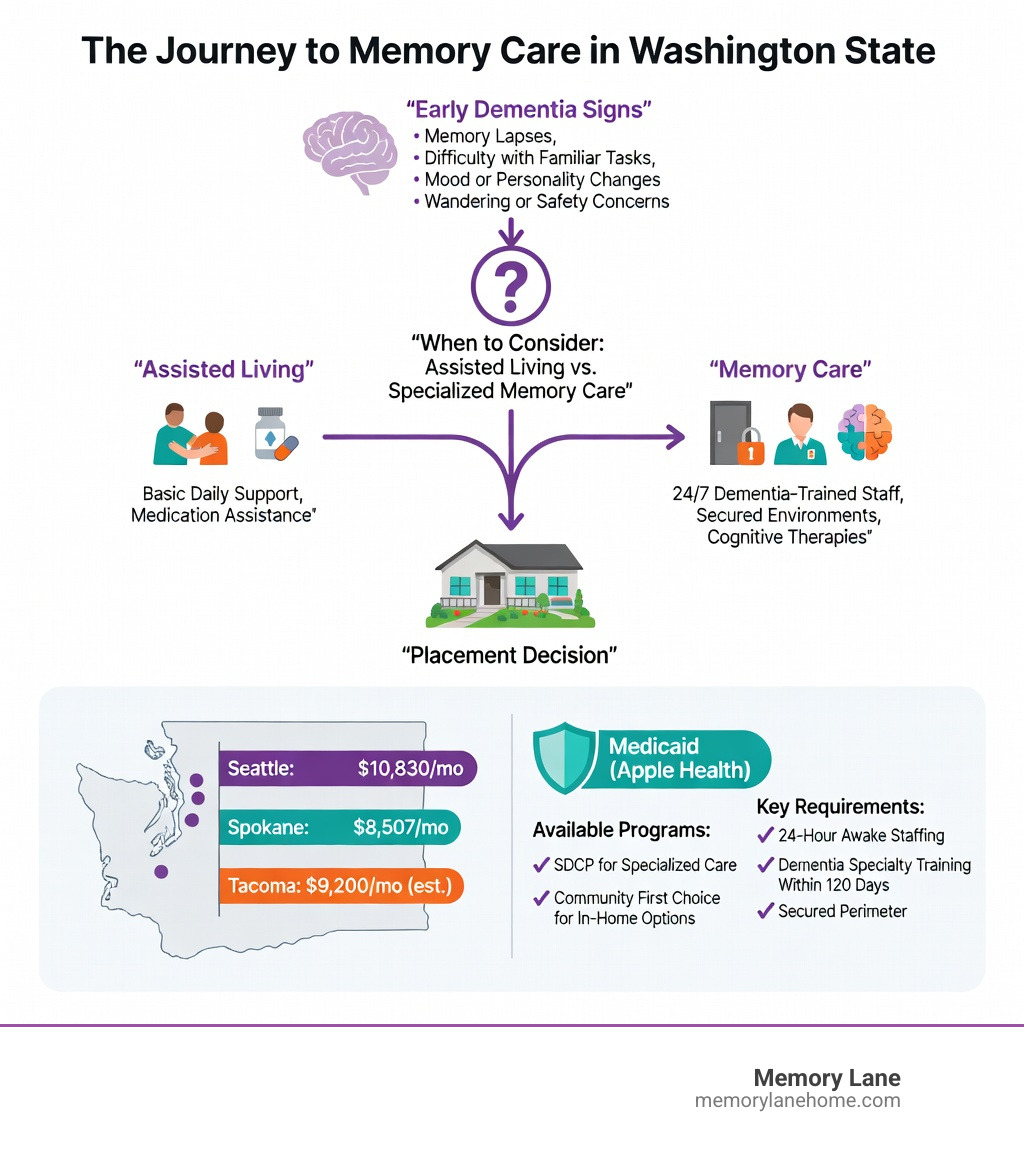
- Average Monthly Cost: $7,831 (2024), with Seattle at $10,830 and Spokane at $8,507
- State Coverage: Medicaid (Apple Health) covers memory care through programs like the Specialized Dementia Care Program (SDCP) and Community First Choice Option
- Key Difference from Assisted Living: Memory care provides 24/7 dementia-trained staff, secured environments, specialized cognitive programming, and behavioral management
- Facilities Available: Over 500 memory care homes across Washington
- Required Staff Training: Dementia specialty training within 120 days, with 24-hour awake staff presence
- Eligibility Requirements: Diagnosis of irreversible dementia, nursing facility level of care (NFLOC) determination, and Medicaid qualification for state-funded programs
Washington ranks 9th-highest in the nation for Alzheimer’s death rates. This isn’t just about statistics, it’s about families watching their loved ones struggle with memory loss and safety concerns. Whether your loved one stays in Washington or relocates to Michigan to be closer to family, the same core principles matter: secure environments, dementia-trained staff, and a care model built around dignity. For many Michigan families, bringing a loved one to a community like Memory Lane in Ann Arbor, Ypsilanti, or Saline means more frequent visits, stronger family involvement, and often lower costs.
Memory care Washington State basics:
Understanding Memory Care Washington State vs. Assisted Living
When families begin their search, they often ask: “Is memory care just assisted living with a locked door?” In Washington, the answer is a resounding no. While both fall under the broad umbrella of assisted living facilities, memory care is a highly specialized tier of service designed specifically for cognitive impairment. The same distinction applies in Michigan, where Memory Lane provides dedicated memory care that goes well beyond standard assisted living.
Standard assisted living is designed for seniors who need help with activities of daily living (ADLs), like bathing or dressing, but can still steer their day with relative independence. Memory care Washington State communities, however, provide 24/7 supervision and “active” safety features. This includes secured perimeters to prevent wandering (elopement) and specialized architectural layouts that reduce confusion, such as circular hallways and clear sightlines.
The care philosophy also shifts. In memory care, the focus is on behavioral management and person-centered care. Rather than just assisting with tasks, staff are trained to manage “sundowning,” agitation, and communication barriers. At Memory Lane in Michigan, we use cognitive support strategies that emphasize what a resident can still do, utilizing science-based programming to keep the mind engaged. Families comparing Washington facilities with Michigan options will find that these core principles are consistent across quality memory care providers in both states.
The Cost of Memory Care in Washington: How It Compares to Michigan
Budgeting for memory care Washington State requires a look at both current rates and the rapid pace of inflation. In 2023, the average cost was approximately $6,893 per month. By 2024, that figure jumped to an estimated $7,831, a significant increase that reflects the rising costs of specialized labor and facility maintenance.
| City | Average Monthly Memory Care Cost (2024 Est.) |
|---|---|
| Seattle | $10,830 |
| Spokane | $8,507 |
| Tacoma | $8,507 |
| Olympia | $6,737 |
| Walla Walla | $4,214 |
Note: Costs vary based on the level of care required and room type.
Seattle remains the most expensive market, often exceeding $10,000 monthly, while cities like Olympia and Walla Walla offer more affordable entry points. Inflation in Washington’s senior living sector rose by 10% between 2022 and 2023, which is slightly lower than the national average but still places a heavy burden on private-pay families.
For Michigan families comparing costs across states, Michigan’s memory care rates tend to be lower than Washington’s major metro areas. This is one of the most common reasons families choose to relocate a loved one closer to adult children in the Ann Arbor area, where the cost of living is more manageable. At Memory Lane in Ann Arbor, Ypsilanti, and Saline, we’re happy to discuss how our pricing compares and help families weigh the financial side of this important decision.
Navigating Medicaid and Financial Assistance for Dementia Care
For many, private pay isn’t sustainable long-term. Fortunately, Washington offers several robust programs to help bridge the gap. The primary vehicle is Apple Health (Washington’s Medicaid), which provides Long Term Services and Supports (LTSS).
Key programs include:
- Specialized Dementia Care Program (SDCP): This is specifically for Medicaid recipients with a dementia diagnosis who can no longer live safely at home. It covers specialized services in contracted assisted living facilities.
- Community First Choice Option (CFC): This helps cover personal care services for those who meet Medicaid’s financial and functional criteria.
- COPES Waiver: The Community Options Program Entry System helps seniors who need a “nursing home level of care” remain in assisted living settings.
- VA Benefits: Veterans and their spouses may qualify for the Aid and Attendance pension, which can provide up to $27,609 annually for a single veteran to help cover care costs.
Financial eligibility for Medicaid in Washington is strict. For 2025, single applicants generally must have an annual income under $30,276 and assets limited to $2,000 (excluding their primary home up to a certain equity limit).
Qualifying for the Specialized Dementia Care Program in Washington State
The Specialized Dementia Care Program is not an entitlement, meaning availability depends on funding and bed space in contracted facilities. To qualify, an applicant must:
- Have a confirmed diagnosis of Alzheimer’s or another irreversible dementia.
- Be eligible for Apple Health Medicaid.
- Meet the Nursing Facility Level of Care (NFLOC) as determined by a DSHS caseworker using the CARE tool.
- Score a minimum of 3 on the cognitive performance scale.
You can apply online through the Washington Connection website or visit a local DSHS office to begin the assessment process.
Relocating from Washington to Michigan: What Families Need to Know
For families considering a move to be closer to relatives in the Ann Arbor area, it is important to note that Medicaid benefits like Apple Health do not transfer between states. If you relocate a loved one to a community like Memory Lane in Michigan, you will need to apply for Michigan’s Medicaid programs separately. Our team at Memory Lane is experienced in helping families steer these interstate transitions, from understanding Michigan Medicaid eligibility to coordinating a smooth move-in process.
Essential Services in Memory Care Washington State Communities
What exactly are you paying for in a memory care Washington State facility? Beyond room and board, these communities provide:
- Medication Management: Ensuring residents take the correct dosages at the right times.
- Sensory Therapy: Using music, art, and tactile activities to stimulate memory and reduce anxiety.
- Secure Walking Paths: Encouraging physical movement in a safe, enclosed outdoor environment.
- Intermittent Nursing: Monitoring health changes and managing chronic conditions.
- ADL Assistance: Hands-on help with eating, bathing, and mobility.
Memory Lane’s communities in Michigan offer these same essential services, along with personalized care plans custom to each resident’s cognitive abilities and preferences.
State Regulations and Staffing Requirements for Washington Facilities
Washington has some of the most comprehensive regulations for memory care in the country, overseen by the Department of Social and Health Services (DSHS) and the Aging and Long-Term Support Administration (ALTSA).
One of the most critical rules is the 120-day training window. All direct care staff in specialized dementia units must complete specialty training within 120 days of hire. Additionally, facilities must maintain 24-hour awake staff to ensure resident safety during the night, when confusion and wandering are most likely to occur.
Facilities are also required to provide a secure outdoor area with walking paths. This is based on research showing that access to fresh air and nature significantly reduces “exit-seeking” behavior and improves sleep patterns in dementia patients. If you ever suspect a facility is failing these standards, concerns can be reported online through DSHS.
How to Choose the Right Facility for Your Loved One
Choosing a memory care Washington State facility is an emotional journey, but it should be guided by objective criteria. Washington law requires a thorough resident assessment within 14 days of move-in. This assessment forms the basis of the individual care plan, which must be updated at least annually or whenever a significant change in health occurs.
When touring, ask these key questions:
- What is the staff-to-resident ratio? While the state doesn’t mandate a specific number, the facility must prove they have enough staff to meet all residents’ needs.
- What are the visitation policies? Current COVID-19 rules generally allow for in-person visits, but it’s wise to ask about their specific screening and safety protocols.
- What are the eviction protections? Under Washington regulations, a facility may only evict a resident if they can no longer meet their medical needs (such as requiring 24-hour skilled nursing care for more than 14 days) or if the resident poses a danger to themselves or others.
For additional support, you can contact the Washington Area Agencies on Aging or the county Long-Term Care Ombudsman for advocacy and information.
Frequently Asked Questions about Memory Care in Washington
What is the average cost of memory care in Washington State?
The average monthly cost for memory care Washington State is approximately $7,831 as of 2024. However, this varies significantly by region, with Seattle averaging over $10,000 and more rural areas like Walla Walla closer to $4,200.
Does Washington Medicaid (Apple Health) cover memory care?
Yes, through programs like the Specialized Dementia Care Program and the COPES waiver. These programs help cover the cost of care services, though residents are typically still responsible for a portion of their room and board costs.
What are the staffing requirements for dementia care in Washington?
Washington requires that all memory care staff complete specialized dementia training within 120 days of hire. Furthermore, facilities must have 24-hour awake staff on-site and provide ongoing annual training to maintain high standards of care.
Conclusion
Understanding memory care Washington State can make a difficult season a little clearer, especially for Michigan families coordinating care across state lines. Many of the families we support at Memory Lane have a parent living in Washington while their adult children are in or moving to the Ann Arbor area. In those cases, families often compare Washington options with the possibility of relocating their loved one to Michigan for more day-to-day involvement, stronger family connections, and often more affordable care.
At Memory Lane, we understand that moving a loved one into memory care is one of the hardest decisions a family can make. Our specialized care communities in Ann Arbor, Ypsilanti, and Saline, Michigan, serve families who want a secure environment and 24/7 dementia-focused support. We share resources like this so families can advocate for quality dementia care and make informed comparisons, whether that care happens in Washington or after an interstate move to be closer to relatives in Michigan.
By focusing on enhancing quality of life and independence, we help families transition from being full-time caregivers back to being daughters, sons, and spouses.
For Washington-specific resources, consider reaching out to the Washington Dementia Action Collaborative or exploring the Washington State Association of Senior Centers for local support. If you are exploring memory care in Michigan and want to learn what a personalized, dementia-focused approach can look like, visit Memory Lane online to explore our services or schedule a tour at one of our communities in the Ann Arbor area.
Related Posts