
Alzheimer’s residential care: 2025 Essential Choices
Why Finding the Right Alzheimer’s Residential Care Matters
Alzheimer’s residential care provides specialized housing and support for individuals with Alzheimer’s disease and other forms of dementia who can no longer safely remain at home. When memory loss progresses and daily tasks become overwhelming, families must steer a complex landscape of care options—from assisted living facilities to specialized memory care units—each offering different levels of medical support, security, and therapeutic programming.
Quick Overview: Types of Alzheimer’s Residential Care
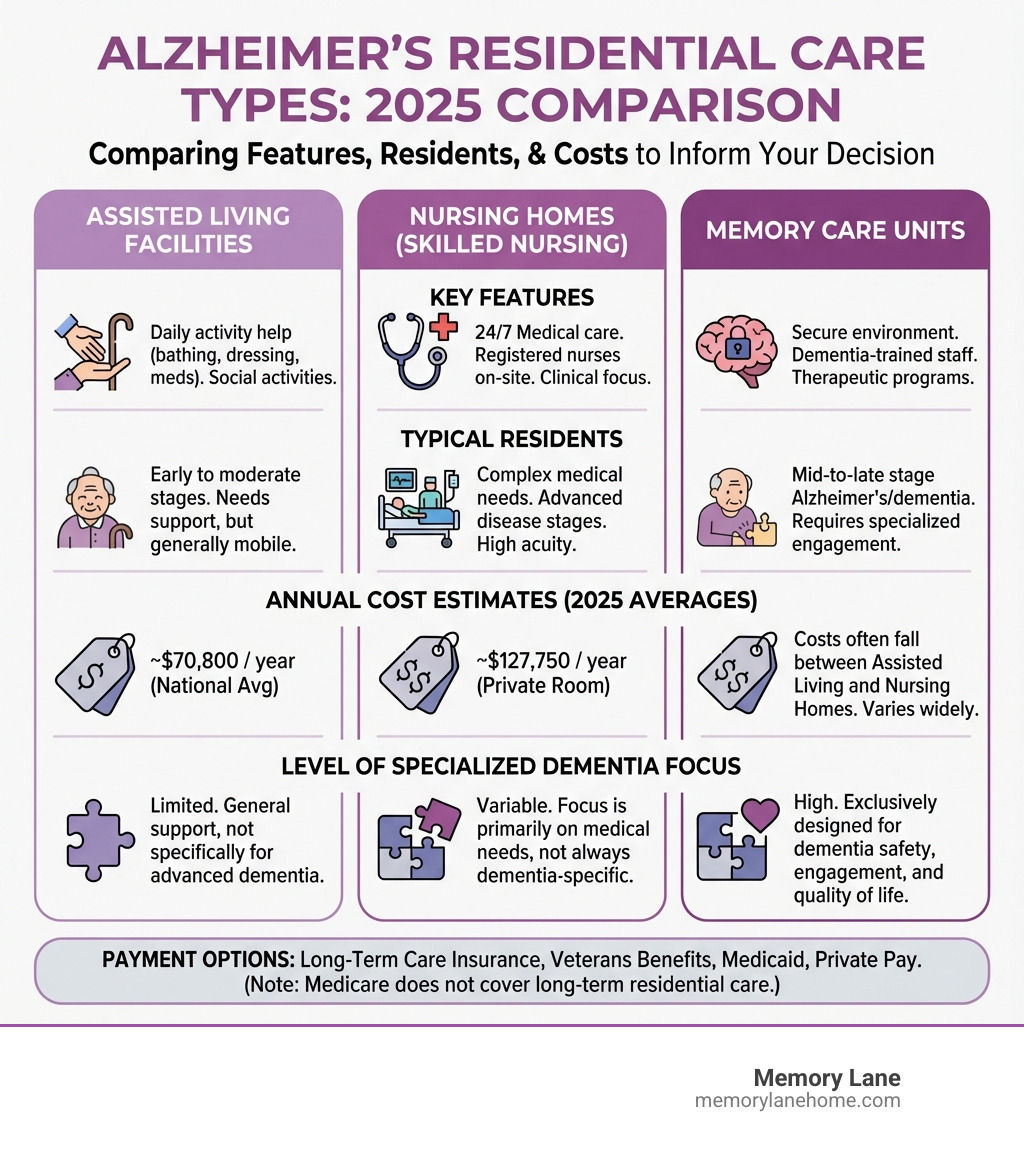
- Assisted Living Facilities: Help with daily activities like bathing, dressing, and medication management; suitable for early to moderate stages
- Nursing Homes (Skilled Nursing): 24/7 medical care with registered nurses on-site; for complex medical needs and advanced stages
- Memory Care Units: Secure, dementia-specialized environments with trained staff, purposeful activities, and sensory therapies
- Continuing Care Communities: Multiple levels of care in one location, allowing residents to “age in place”
This decision is rarely easy. According to the Alzheimer’s Association, caregivers often experience guilt, sadness, and relief all at once when considering residential care. But it’s important to remember: moving a loved one to specialized care isn’t giving up—it’s ensuring they receive the round-the-clock support and safety they deserve.
The costs vary widely. The national average for assisted living is $70,800 per year, while a private nursing home room averages $127,750 annually. In Canada, government-run long-term care may start around $2,800 per month, while private facilities can begin at $3,900 or more. Payment options include long-term care insurance, Veterans benefits, Medicaid, and private pay—though Medicare does not cover long-term residential care.
Currently, 564,000 Canadians live with dementia, and this number is expected to reach 1.4 million by 2031. In the United States, millions more face similar journeys. Finding the right Alzheimer’s residential care means balancing medical needs, safety, quality of life, and financial realities.
I’m Jason Setsuda, a Board Certified Emergency Medicine Physician and CFO of Memory Lane Assisted Living, with over 10 years of medical experience and a deep commitment to helping families steer Alzheimer’s residential care decisions. My work across emergency medicine, hospice, and assisted living has shown me how critical it is to find compassionate, specialized care that honors both the person with dementia and their family.
Recognizing the Signs: When to Consider Residential Care
Making the decision to transition a loved one into Alzheimer’s residential care is one of the most challenging a family can face. It often comes after months, or even years, of dedicated home care. But there comes a point when the needs of the individual with Alzheimer’s or dementia become too great for home care to safely and effectively manage, or when the caregiver’s own health and well-being are significantly compromised.
We understand that this decision can evoke a range of emotions, including guilt, sadness, and even relief. It’s crucial to acknowledge these feelings and recognize that seeking professional residential care is a loving and responsible choice to ensure optimal well-being for everyone involved.
Is the person’s safety at risk at home?
The progression of Alzheimer’s disease often brings increased safety concerns. What once seemed manageable can quickly become dangerous. We often see families grapple with situations where a loved one:
- Wanders: A significant concern, as individuals with dementia can easily get lost, even in familiar surroundings. This risk increases during sundowning hours.
- Experiences falls: As mobility declines and judgment is impaired, falls become more frequent and can lead to serious injuries.
- Makes medication errors: Forgetting doses, taking too much, or mixing medications can have severe health consequences.
- Engages in unsafe cooking practices: Leaving stoves on, forgetting food, or misusing appliances can lead to fires or other household accidents.
- Leaves home unattended: This can expose them to dangers like traffic, inclement weather, or exploitation.
- Is unable to respond to emergencies: Whether it’s a fire, a medical crisis, or an intruder, a person with advanced dementia may not be able to react appropriately.
These escalating risks can make independent living, or even supervised home living, untenable.
Are the caregiver’s well-being and health declining?
Caregiving for someone with Alzheimer’s is a demanding, 24/7 role that can take a severe toll on the caregiver’s physical and mental health. We’ve seen how chronic stress can lead to:
- Caregiver stress and burnout: The constant demands can lead to emotional exhaustion, detachment, and a reduced sense of personal accomplishment.
- Sleep deprivation: Waking up frequently to assist or check on a loved one can lead to chronic fatigue.
- Neglecting personal health: Caregivers often put their loved one’s needs before their own, skipping doctor’s appointments, healthy meals, or exercise.
- Social withdrawal and isolation: The demands of caregiving can make it difficult to maintain social connections, leading to loneliness.
- Impatience and irritability: While completely understandable given the circumstances, these feelings can strain relationships and impact the quality of care provided.
As the Alzheimer Society of Canada rightly points out, it’s important to balance the needs of the person you’re caring for with your own well-being. You shouldn’t have to do it all alone. If you find yourself exhibiting signs of severe caregiver stress, it’s a clear indicator that additional support, such as residential care, may be necessary.
Are the person’s care needs becoming too complex?
As Alzheimer’s progresses, the level of care required intensifies. What might have started as occasional assistance can evolve into complex, round-the-clock needs that go beyond what a family caregiver can realistically provide.
- 24/7 supervision: Many individuals with advanced dementia require constant monitoring to prevent wandering, falls, or other safety issues.
- Incontinence care: Managing incontinence can be physically and emotionally challenging for family caregivers.
- Mobility assistance: Helping a loved one transfer, walk, or use a wheelchair may require specialized training or physical strength.
- Advanced medical needs: As health conditions become more complex, the need for skilled nursing care or frequent medical interventions increases.
- Behavioral challenges: Agitation, aggression, hallucinations, or severe sundowning can be incredibly difficult to manage safely at home, often requiring specialized approaches and environments.
When these needs become overwhelming, a residential care setting with trained professionals and a supportive environment can provide the specialized care that we all want for our loved ones.
Understanding the Types of Alzheimer’s Residential Care
When considering Alzheimer’s residential care for a loved one in Ann Arbor, Ypsilanti, or Saline, Michigan, it’s important to understand that there isn’t a one-size-fits-all solution. Different facilities offer varying levels of care, services, and environments custom to the diverse needs of individuals living with dementia. Our goal is to help you find the best fit, ensuring comfort, safety, and a good quality of life.
Assisted Living Facilities
Assisted living facilities are designed for individuals who need some help with daily activities but can still maintain a degree of independence. They bridge the gap between living completely independently and requiring 24-hour medical nursing care.
- Independence with support: Residents often have their own apartments or rooms, but receive assistance with tasks like bathing, dressing, grooming, and medication management.
- Social programs: These facilities typically offer a vibrant social calendar with activities, outings, and communal dining, which can combat social isolation.
- Not always dementia-specialized: While many assisted living facilities cater to older adults, not all are specifically equipped or staffed to handle the unique challenges of Alzheimer’s and dementia. If your loved one has cognitive decline, it’s crucial to inquire about their dementia care programs.
Nursing Homes (Skilled Nursing Facilities)
Nursing homes, also known as skilled nursing facilities, provide the highest level of medical care outside of a hospital. They are suitable for individuals with complex medical conditions or advanced stages of dementia who require constant medical supervision and assistance.
- 24-hour medical care: Registered nurses and other licensed medical professionals are on-site around the clock to administer medications, manage chronic conditions, and provide complex medical treatments.
- For complex medical conditions: These facilities are ideal for individuals who need extensive physical therapy, wound care, or have multiple comorbidities.
- Post-hospitalization care: Often, individuals transition to a nursing home for short-term rehabilitation after a hospital stay.
Specialized Memory Care Units
Specialized Memory Care Units, often found within assisted living facilities or as standalone communities, are specifically designed for individuals with Alzheimer’s disease and other forms of dementia. These units are increasingly common in Ann Arbor, Ypsilanti, and Saline, Michigan, recognizing the unique needs of this population.
- Secure environments: These units feature secure perimeters, often with alarms or coded entry systems, to prevent wandering and ensure resident safety. This gives families immense peace of mind.
- Dementia-trained staff: Staff members receive specialized training in dementia care, understanding how to communicate effectively, manage challenging behaviors, and provide person-centered support. This training is vital for creating a calm and supportive atmosphere.
- Purposeful activities: Activities are custom to cognitive abilities, focusing on engagement, sensory stimulation, and maintaining daily living skills. Examples include art therapy, music programs, gentle exercise, and reminiscence activities.
- Sensory therapies: Some facilities incorporate Snoezelen therapy rooms or other sensory-rich environments that can help alleviate agitation and provide moments of calm and clarity.
- Person-centered care: The care approach emphasizes the individual’s history, preferences, and remaining abilities, fostering a sense of dignity and purpose. This means understanding their unique story and celebrating who they are.
- Reduced agitation: The combination of a secure, predictable environment, specialized staff, and custom activities often leads to a reduction in agitation and an increase in overall well-being.
At Memory Lane, we specialize in this type of care, offering a dedicated environment where residents can thrive. You can Learn more about specialized dementia care at Memory Lane.
Continuing Care Options
Some communities, known as Continuing Care Retirement Communities (CCRCs) or Life Plan Communities, offer a comprehensive range of care levels within a single campus. This can be an excellent option for long-term planning.
- Aging in place: Residents can transition from independent living to assisted living, and then to skilled nursing or memory care, all within the same community. This minimizes the stress of multiple moves as needs change.
- Continuum of care: These communities provide a seamless progression of care, allowing individuals to maintain familiar surroundings and relationships even as their health needs evolve.
| Feature | Assisted Living Facilities | Nursing Homes | Specialized Memory Care Units |
|---|---|---|---|
| Level of Care | Assistance with ADLs (bathing, dressing, meds) | 24/7 medical and skilled nursing care | High-level personal care, behavioral management, cognitive support |
| Typical Resident | Needs some help but largely independent | Complex medical conditions, advanced frailty, skilled rehab | Moderate to advanced dementia, wandering risk, behavioral changes |
| Environment | Apartment-like, social, less structured | Clinical, hospital-like, highly structured | Secure, residential, sensory-friendly, dementia-specific design |
| Cost | National average: $70,800/year | National average: $127,750/year (private) | Often higher than standard assisted living, varies widely |
How to Choose the Right Facility: A Step-by-Step Guide
Choosing the right Alzheimer’s residential care for your loved one in Ann Arbor, Ypsilanti, or Saline, Michigan, can feel like a monumental task. It involves careful evaluation, asking the right questions, and trusting your instincts. We’re here to guide you through this process, helping you make an informed decision that brings peace of mind.

Key Services and Amenities in Alzheimer’s residential care
When evaluating potential facilities, we look beyond the aesthetics to understand the core services and amenities that truly impact a resident’s quality of life. For someone with Alzheimer’s, these often include:
- 24/7 staff: Constant supervision and assistance are critical for safety and immediate response to needs.
- Emergency alert systems: Whether pendants or in-room call buttons, these ensure help is always within reach.
- Meal services: Nutritious, appealing meals are essential. We’d want to know about dietary accommodations, dementia-friendly menus, and assistance during mealtimes.
- Housekeeping and laundry: These services ensure a clean and comfortable living environment.
- Transportation: Access to medical appointments, shopping, and community outings is important for maintaining engagement.
- Personalized care plans: A good facility will develop a care plan custom to your loved one’s specific needs, abilities, and interests, and update it regularly.
- Physical and occupational therapy: On-site or accessible therapies can help maintain mobility and daily living skills.
- Social and recreational activities: Engaging programs designed for individuals with dementia are crucial for cognitive stimulation and social interaction.
Evaluating a Facility: Your On-Site Visit Checklist
Visiting facilities is perhaps the most critical step. We recommend making both scheduled and unannounced visits to get a true sense of the daily environment. Here’s what we suggest you observe and inquire about during your tours:
- Staff-resident interactions: Do staff members interact with residents patiently, respectfully, and with warmth? Do they engage in conversation and make eye contact? This is a huge indicator of the facility’s culture.
- Cleanliness and odors: A clean facility free of unpleasant odors is a must. Pay attention to common areas and resident rooms.
- Safety features: Look for secure entrances/exits, call bells, grab bars in bathrooms, and clear pathways. For memory care, secure outdoor spaces are vital.
- Resident engagement: Are residents actively participating in activities, or are many sitting idly? Do they appear comfortable, relaxed, and well-groomed?
- Outdoor access: Is there a safe and easily accessible outdoor area for residents to enjoy fresh air and sunshine?
- Dining experience: Observe a mealtime. Is the food appetizing? Is the dining area pleasant? Is assistance provided discreetly and respectfully? Are family and friends able to join at mealtime?
- Personalization: Are residents allowed to bring familiar items from home to make their rooms feel more personal and comforting?
For a comprehensive guide, we suggest you Use this checklist when visiting care homes. It helps ensure you cover all your bases.
Ensuring Quality of Care and Resident Well-being
Beyond what you observe, we encourage you to dig deeper into the facility’s operational standards and reputation:
- Staff-to-resident ratio: A higher ratio often indicates more personalized attention. Inquire about the ratio during peak and off-peak hours.
- Staff training and turnover: Ask if staff are specifically trained in dementia care, how long the training is, what topics are covered, and what the average tenure of staff members is. High turnover can be a red flag.
- Inspection reports: Always ask to see the latest survey/inspection report. These reports, often from state regulatory bodies, highlight any deficiencies or areas of concern.
- Licensing and certification: Confirm that the facility is properly licensed by the state of Michigan and any relevant certifications, especially for memory care units.
You can also Check a facility’s quality rating using Medicare’s Care Compare tool for nursing homes. While this tool is primarily for nursing homes, it provides valuable insights into quality metrics that can inform your decision. For assisted living and memory care facilities in Michigan, you’ll need to consult state licensing agencies for similar reports.
Navigating the Costs and the Transition to Care
Understanding the financial implications and preparing for the emotional journey of transitioning a loved one into Alzheimer’s residential care are crucial steps. We want to empower you with information, so you feel confident and supported throughout this process.
Understanding the Average Costs
The costs associated with Alzheimer’s residential care can vary significantly depending on the type of facility, the level of care required, and geographic location. While we focus on Ann Arbor, Ypsilanti, and Saline, Michigan, national averages can give us a baseline:
- National average costs: The national average cost for basic services in an assisted living setting is $70,800 per year. For a nursing home, the average cost for a private room is $127,750 per year, and a semi-private room averages $111,324 per year.
- Assisted living costs: These typically cover room and board, help with activities of daily living (ADLs), medication management, and social activities. Specialized memory care units within assisted living often come at a higher cost due to the increased staffing and specialized programming.
- Nursing home costs: These higher costs reflect 24-hour skilled nursing care, medical supervision, and extensive personal care.
- Private vs. semi-private rooms: Opting for a semi-private room can often reduce costs compared to a private room.
- A la carte services: Be sure to understand what is included in the base fee and what services might incur additional charges. This could include therapies, specialized medical equipment, or certain activities.
For a detailed breakdown of costs, the Genworth Cost of Care Survey is an excellent resource that provides state-specific data.
Exploring Payment Options for Alzheimer’s residential care
Funding Alzheimer’s residential care requires careful financial planning. Here are the common payment avenues:
- Private pay: Most individuals initially pay for residential care using their personal savings, pensions, or long-term care insurance.
- Long-term care insurance: If your loved one has a long-term care insurance policy, it may cover a portion of the costs for assisted living, memory care, or nursing home care. Review the policy carefully to understand its benefits, waiting periods, and daily limits.
- Veterans benefits: Eligible veterans and their spouses may qualify for Aid & Attendance benefits, which can help cover the costs of assisted living or nursing home care.
- Medicaid: Medicaid is a state and federal program that provides healthcare coverage to low-income individuals. It can cover nursing home costs for eligible individuals once their assets and income fall below certain thresholds. Some states also have Medicaid waiver programs that cover assisted living or memory care. We recommend consulting with an elder care lawyer in Michigan to understand eligibility requirements.
- Medicare limitations: Medicare generally does not cover long-term residential or custodial care. It typically only covers short-term skilled nursing care following a qualifying hospital stay.
The Family’s Role and Support Resources
Your role as a family member doesn’t end when a loved one moves into residential care; it simply shifts. We believe family involvement is crucial for the resident’s well-being and for ensuring quality care.
- Care plan meetings: Actively participate in care plan meetings with facility staff. These meetings are your opportunity to discuss your loved one’s needs, preferences, and progress, and to advocate for their best interests.
- Advocating for your loved one: You become their primary advocate, ensuring their care plan is being followed, their needs are met, and they are treated with dignity and respect. Don’t hesitate to voice concerns or ask questions.
- Making the move easier: Moving day can be stressful for everyone, especially for someone with dementia. Try to make their new room feel familiar by bringing cherished photos, furniture, or comfort items. Maintain a positive attitude and reassure them.
- Coping with guilt and relief: It’s okay to feel a mix of emotions. Many caregivers experience guilt, but also a sense of relief knowing their loved one is in a safe, supportive environment with professional care. Seek support from family, friends, or caregiver support groups.
There are many resources available to help families steer this journey. The Community Resource Finder is an excellent tool to locate Alzheimer’s and dementia care providers, community services, and support groups in your local area, including Ann Arbor, Ypsilanti, and Saline, Michigan.
Frequently Asked Questions about Alzheimer’s Residential Care
What is the main difference between a memory care unit and standard assisted living?
The main difference lies in the specialization and intensity of care provided. While standard assisted living offers support with daily activities and medication management, a memory care unit provides a higher level of specialized care custom specifically for individuals with dementia. This includes staff who are extensively trained in dementia communication techniques and behavior management, a secure environment designed to prevent wandering, and activities that are purposeful and adapted for cognitive engagement. Memory care environments are often designed to be less stimulating and more predictable, which can reduce agitation and confusion for residents with Alzheimer’s.
How do I know for sure it’s the right time for a move?
The decision is often necessary when a loved one’s safety is significantly at risk at home, their care needs exceed what can be safely and effectively provided by family caregivers, or the primary caregiver’s physical and mental health is suffering significantly. Signs such as frequent wandering, increased falls, inability to manage personal hygiene, severe behavioral changes (aggression, agitation), or the caregiver experiencing burnout and neglecting their own health are strong indicators that it’s time to consider residential care. It’s a complex decision, and often a social worker or geriatric care manager can help assess the situation objectively.
Does Medicare pay for Alzheimer’s residential care?
No, Medicare does not typically cover long-term residential or custodial care. Medicare is primarily for acute medical care and short-term skilled nursing or rehabilitation. It may cover short-term skilled nursing care following a qualifying hospital stay, but it is not a payment source for long-term room and board, personal care, or supervision in an assisted living or memory care facility. Payment for these services usually comes from private funds, long-term care insurance, or Medicaid (for eligible individuals, often specifically for nursing home care or through waiver programs for assisted living).
Conclusion
Making the decision to choose Alzheimer’s residential care for a loved one is one of the most profound and often difficult choices a family will face. It marks a significant transition, not just for the individual with dementia, but for the entire family unit. We understand the weight of this decision and hope this guide has provided you with clarity, support, and the confidence to steer the options available in Ann Arbor, Ypsilanti, and Saline, Michigan.
Our ultimate goal is to empower families to make informed choices that prioritize the safety, dignity, and quality of life for those living with Alzheimer’s and other dementias. Choosing residential care is not a failure; it is an act of love and a strategic step to ensure comprehensive, specialized support when home care is no longer sustainable.
For families seeking a compassionate and specialized environment, facilities like Memory Lane offer dedicated dementia care services designed to improve quality of life. We believe in fostering a sense of purpose, belonging, and joy for our residents, treating each individual with the respect and personalized attention they deserve.