
Your Wallet & Their Well-being: Understanding Tax Deductions for Dementia Care
Understanding the Financial Relief Available for Your Loved One’s Care
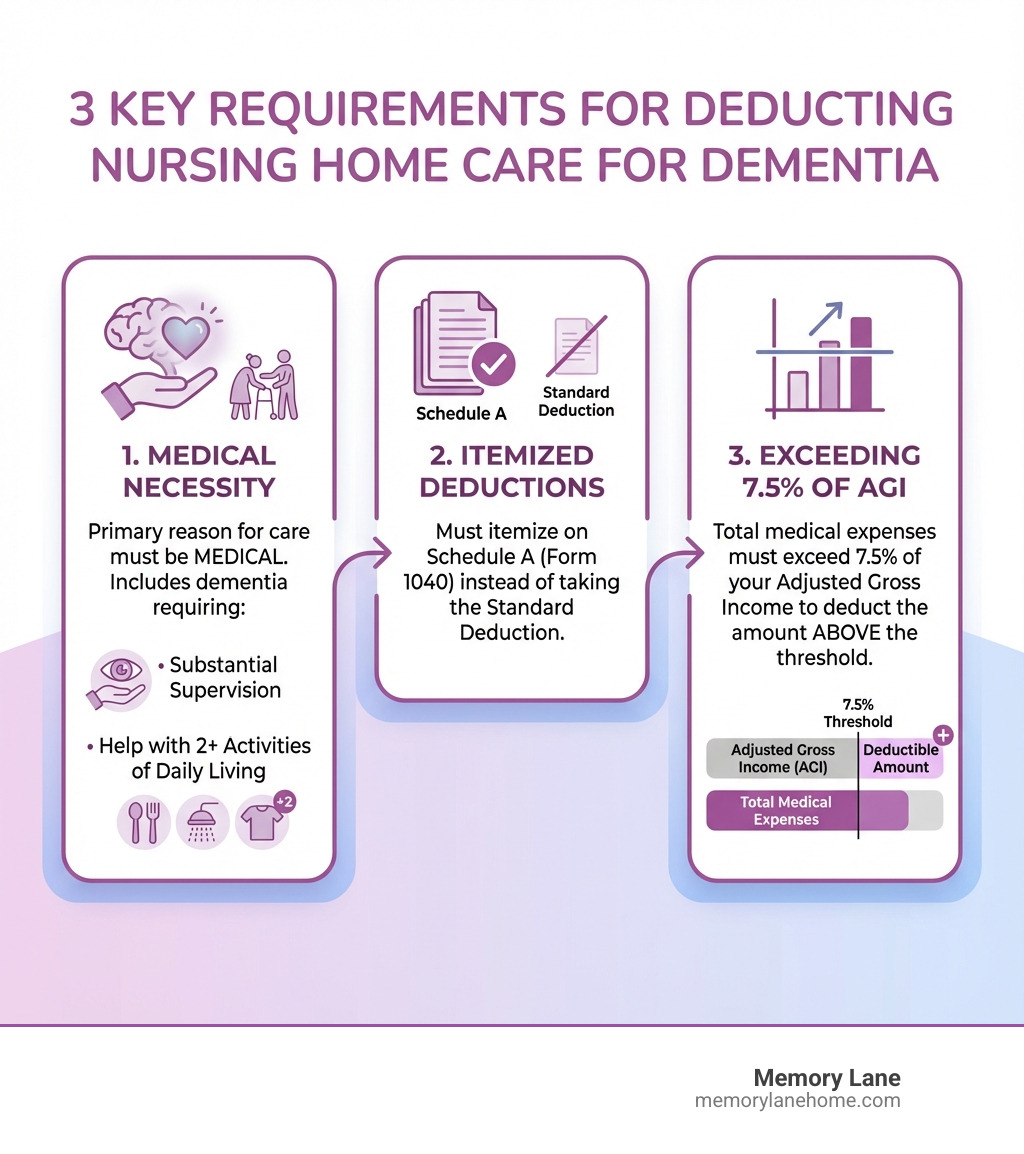
Is nursing home care for dementia tax deductible? Yes, in most cases. The IRS allows you to deduct nursing home expenses as medical costs if:
- The primary reason for care is medical necessity (not just personal preference).
- You itemize your deductions on Schedule A instead of taking the standard deduction.
- Your total medical expenses exceed 7.5% of your Adjusted Gross Income (AGI).
- The person with dementia is you, your spouse, or your qualifying dependent.
If these conditions are met, you can typically deduct 100% of the nursing home costs, including meals and lodging, for the portion that exceeds the 7.5% AGI threshold.
Caring for someone with dementia is emotionally challenging, and the financial burden can be overwhelming. With national average costs for nursing home care ranging from $8,669 to $9,733 per month, understanding your tax options is crucial. The good news is that the IRS recognizes dementia care as a legitimate medical expense, which can significantly reduce your tax burden.
However, the rules are specific. You must meet certain criteria and have the right documentation. As Jason Setsuda, CFO of Memory Lane Assisted Living and a Board Certified Emergency Medicine Physician with over 10 years of medical experience, I’ve helped countless families steer the intersection of quality dementia care and financial planning. My goal is to help you make informed decisions that protect both your loved one’s well-being and your family’s financial health.
The Foundation: Qualifying for Medical Expense Deductions
To deduct medical expenses, you must itemize your deductions on Schedule A (Form 1040) rather than taking the standard deduction. This is often worthwhile when facing significant costs like dementia care. A key rule is the 7.5% AGI threshold: you can only deduct the amount of your total medical expenses that exceeds 7.5% of your Adjusted Gross Income (AGI).
For detailed guidance, the IRS provides Publication 502, Medical and Dental Expenses.
What counts as a deductible medical expense?
The IRS defines medical expenses broadly, covering costs for diagnosis, treatment, and prevention of disease. For dementia care, this includes:
- Medical services: Doctor visits, diagnostic tests, therapies (physical, occupational, speech), and medication management.
- Long-term care services: This is a major category, covering assistance with Activities of Daily Living (ADLs) like bathing, dressing, and eating. It also includes specialized dementia care services provided in facilities like Memory Lane.
- Other costs: Prescription drugs, medical equipment (walkers, etc.), transportation to medical appointments, and premiums for qualified long-term care insurance.
The breadth of these categories means many costs associated with dementia care in Ann Arbor, Ypsilanti, or Saline, Michigan, may be deductible.
How is the 7.5% AGI threshold calculated?
Your Adjusted Gross Income (AGI) is your gross income minus certain specific deductions. To find your deductible amount, first calculate 7.5% of your AGI. This is your “floor.” You can only deduct the portion of your unreimbursed medical expenses that exceeds this floor.
For example, if your AGI is $38,000, your floor is $2,850 (7.5% of $38,000). If your total eligible medical expenses were $15,000, you could deduct $12,150 ($15,000 – $2,850). This can result in a significant tax saving, highlighting the importance of meticulous record-keeping.
Is Nursing Home Care for Dementia Tax Deductible? The Core Criteria
The key to determining if nursing home care for dementia is tax deductible lies in the reason for the residency. The IRS draws a clear line between care for medical reasons and care for personal convenience. This distinction is crucial when considering the deductibility of lodging and meals.

For individuals with dementia, the need for substantial supervision and assistance with daily tasks usually establishes a clear medical necessity.
When is nursing home care for dementia tax deductible based on the reason for residency?
If the primary reason for being in a nursing home is to receive medical care, the entire cost—including meals and lodging—can be deductible as a medical expense. This is often the case for residents in specialized memory care facilities like Memory Lane in Ann Arbor, Ypsilanti, or Saline.
However, if the stay is for non-medical, personal reasons, only the portion of the fees that covers direct medical care is deductible. The costs for meals and lodging would not be. The IRS guidance on special care expenses clarifies this distinction.
How a ‘chronically ill’ diagnosis determines if nursing home care for dementia is tax deductible
The IRS has a specific definition of “chronically ill” that is incredibly important for the tax deductibility of dementia care. To deduct the full cost of care, including room and board, the individual must be certified as “chronically ill” by a licensed health care professional on an annual basis. A person is considered chronically ill if they meet one of two conditions:
- Inability to perform Activities of Daily Living (ADLs): They are unable to perform at least two ADLs (like bathing, dressing, eating, continence, toileting, or transferring) without substantial assistance for at least 90 days.
- Substantial supervision due to cognitive impairments: They require significant supervision to protect their health and safety due to a severe cognitive impairment, such as Alzheimer’s disease or another form of dementia.
Most individuals with dementia meet the “substantial supervision” criterion. This certification is vital for claiming the full deduction for care in facilities like ours and ensures the medical necessity is properly documented.
Who Can Claim the Deduction and What Documentation is Needed?
Understanding who can claim these vital deductions and what paperwork the IRS expects is key to successfully navigating the tax season. Whether it’s for yourself, your spouse, or a qualifying dependent, the rules are specific, and documentation is your best friend.
Can I claim nursing home expenses for a parent or relative?
Yes, you can, provided you claim them as a dependent. To be a “qualifying relative,” the person must meet several IRS tests, including:
- Relationship/Household Test: They must be a relative or live with you all year.
- Gross Income Test: Their gross income must be below a certain threshold (for 2024, this was $5,050).
- Support Test: You must provide more than half of their total support for the year.
If multiple family members contribute to the support, you may be able to use a “Multiple Support Declaration”. This allows one person from the group to claim the dependent each year, provided the group collectively provides over 50% of the support and the individual claiming the deduction provides at least 10%.
What documentation should I keep for the IRS?
Thorough documentation is non-negotiable for the IRS. Keep detailed records of all expenses to substantiate your claim. This includes:
- Itemized invoices from the facility: These should clearly separate medical services from other costs.
- Doctor’s certification of medical necessity: An annual certification from a licensed health care professional stating that your loved one is “chronically ill” as defined by the IRS.
- Plan of care: A written plan prescribed by a licensed health care practitioner.
- Proof of payment: Canceled checks, credit card statements, or bank transfer confirmations.
- Receipts: For all related out-of-pocket medical expenses, such as prescriptions or transportation.
Comparing Care Settings, Insurance, and Other Financial Factors
The landscape of dementia care is varied, offering options from residential memory care facilities like Memory Lane to in-home care services. Each setting has unique financial implications for tax deductibility.
How do deductions differ for residential memory care or in-home care?
The core principle for deductions in any setting is medical necessity.
- Residential Memory Care: For facilities like Memory Lane, which are designed for individuals with cognitive impairments, the primary reason for residency is almost always medical care. If a doctor certifies the resident as “chronically ill,” the entire cost—including room, board, and all care services—is generally considered a deductible medical expense.
- In-Home Care: When hiring a caregiver at home, only the costs for direct medical and personal care services are deductible. This includes wages for a nurse or aide providing assistance with Activities of Daily Living (ADLs). General household expenses, like food or rent, are not deductible. You must be diligent in separating medical care costs from other household expenses.
For both settings, you’ll need a doctor’s certification and a plan of care to prove medical necessity. For more information about the specialized care we offer, please visit our page on dementia care services.
Can I deduct long-term care insurance premiums?
Yes, premiums for qualified long-term care insurance policies are considered a medical expense. The amount you can deduct is capped based on your age and is adjusted annually by the IRS. For example, for 2023, individuals age 71 or older could deduct up to $6,970. Check the latest IRS guidelines for current-year limits.
How do insurance or government subsidies affect my deduction?
You can only deduct your out-of-pocket medical expenses. Any costs reimbursed by insurance (like a long-term care policy) or covered by government programs (like Medicaid or Medicare) must be subtracted from your total medical expenses before you calculate your deduction. You cannot deduct expenses that someone else paid for.
Frequently Asked Questions about Dementia Care Tax Benefits
We understand that taxes can be complex, especially when layered with the emotional and financial challenges of dementia care. Here, we address some of the most common questions we hear from families in Ann Arbor, Ypsilanti, and Saline, Michigan.
What is the difference between a tax deduction and a tax credit?
This is a fundamental distinction that can significantly impact your tax liability:
- Tax Deduction: A tax deduction reduces your taxable income. If you have $70,000 in taxable income and claim $10,000 in deductions, you are taxed on $60,000. The value of the deduction depends on your tax bracket.
- Tax Credit: A tax credit directly reduces your tax liability dollar-for-dollar. A $500 tax credit reduces your tax bill by $500. Credits are generally more valuable than deductions.
The medical expense deduction is a tax deduction. An example of a related credit is the Child and Dependent Care Credit, which may apply if you pay for care so you can work.
What if I hire someone for in-home dementia care?
Hiring an in-home caregiver in Michigan may classify you as a “household employer” with the IRS. This comes with responsibilities like withholding and paying Social Security, Medicare, and federal unemployment (FUTA) taxes.
These rules generally apply if you pay cash wages of $2,600 or more (for 2023, this amount is adjusted annually) to any one household employee. If you meet this threshold, you’ll need to file Schedule H (Form 1040), Household Employment Taxes. The IRS provides detailed guidance in IRS Publication 926, Household Employer’s Tax Guide. Consulting a tax professional is highly recommended to ensure you handle payroll and taxes correctly.
Conclusion: Taking the Next Steps for Financial Peace of Mind
Navigating the financial complexities of dementia care can be challenging, but understanding that nursing home care for dementia is tax deductible can provide significant financial relief.
Remember the key takeaways:
- Medical necessity is crucial. A “chronically ill” diagnosis certified by a doctor is the foundation for deducting the full cost of care, including room and board.
- Documentation is paramount. Keep detailed records of all expenses, payments, and medical certifications.
- Deductions are based on your out-of-pocket costs that exceed 7.5% of your Adjusted Gross Income (AGI), and you must itemize your deductions.
While this guide provides a strong overview, tax laws are complex. We strongly recommend consulting a qualified tax professional or elder law attorney. They can offer personalized advice for your situation in Ann Arbor, Ypsilanti, or Saline, Michigan, helping you maximize deductions and ensure compliance.
At Memory Lane, we believe that understanding your financial options is an integral part of providing the best quality of life for your loved one. Our mission is to offer personalized, compassionate support for individuals with dementia and Alzheimer’s. We are here to support you and your family every step of the way.