
Assisted Living Costs Michigan: Budget Smart 2024
Understanding What Assisted Living Really Costs in Michigan
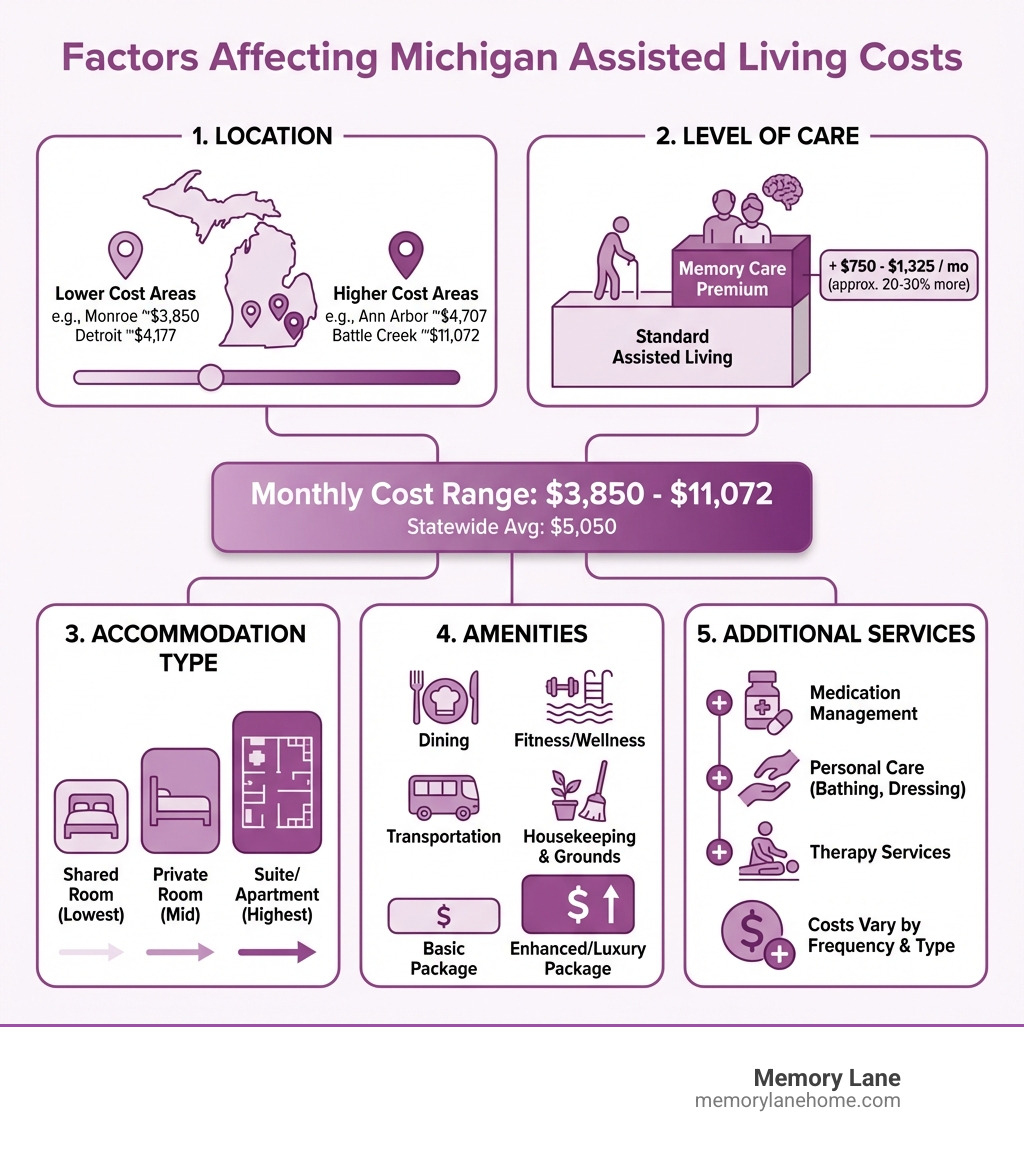
Assisted living costs Michigan families need to understand range from approximately $3,850 to $11,072 per month, depending on location and level of care required. The statewide average sits around $5,050 monthly, slightly below the national average of $5,350.
Quick Cost Overview
| Cost Factor | Details |
|---|---|
| Statewide Average | $5,050/month ($60,600/year) |
| Lowest Cost Area | Monroe – $3,850/month |
| Highest Cost Area | Battle Creek – $11,072/month |
| Memory Care Premium | Additional $750-$1,325/month |
| National Comparison | Michigan is $300 below U.S. average |
Major City Costs:
- Detroit: $4,177/month
- Grand Rapids: $4,696/month
- Ann Arbor: $4,707/month
- Lansing: $4,839/month
If you’re caring for someone with memory loss or dementia, understanding these costs becomes even more critical. The financial burden of care can feel overwhelming when you’re already managing the emotional weight of watching a loved one’s cognitive decline.
Many families are surprised to learn that memory care services typically cost 20-30% more than standard assisted living. This premium reflects specialized staffing, secure environments, and programs designed specifically for those with Alzheimer’s or dementia.
The good news? Michigan offers several financial assistance programs. The MI Choice Waiver Program helps eligible seniors with monthly incomes below $2,901 access care services, though it doesn’t cover room and board. Veterans may qualify for Aid and Attendance benefits, and long-term care insurance policies often provide coverage.
Location matters significantly. A family in Monroe might pay $3,850 monthly, while someone in Battle Creek could face costs exceeding $11,000. These regional differences reflect local cost of living, demand, and available amenities.
I’m Jason Setsuda, CFO of Memory Lane Assisted Living and a board-certified Emergency Medicine Physician who has spent years helping families steer assisted living costs Michigan families face when seeking quality care for loved ones with dementia. My dual background in healthcare and senior living finance gives me unique insight into both the medical and financial aspects of memory care planning.
Assisted living costs Michigan word guide:
Understanding the Average Assisted Living Costs Michigan
When we begin to explore senior living options, one of the first and most pressing questions is always about cost. In Michigan, the financial landscape for assisted living can seem complex, but we’re here to help clarify it.
The average monthly cost of assisted living in Michigan is approximately $5,050. This figure, often cited from sources like Genworth’s 2023 Cost of Care Survey, translates to roughly $60,600 per year. While some data points suggest a higher average, such as $6,008 per month from some providers, the $5,050 figure is a widely referenced statewide average. This is slightly below the national average of $5,350 per month, making Michigan a comparatively more affordable state for assisted living care.
However, the journey to finding suitable care isn’t just about a single average number. The cost of assisted living is on an upward trajectory. From 2022 to 2023, Michigan saw a significant 12% increase in assisted living costs, with projections indicating another 11.3% rise in 2024. These increases are driven by factors like rising demand from the aging Baby Boomer population and ongoing staffing shortages within the industry. This means that while current costs are important, it’s equally crucial to consider projected increases when planning long-term. By the year 2030, for example, the annual cost for assisted living in Michigan is projected to reach almost $65,000.
Understanding these trends and averages is a vital first step in budgeting for care.
How do assisted living costs Michigan vary by city?
Location is one of the most significant determinants of assisted living costs Michigan. Just as real estate prices fluctuate from one neighborhood to another, so too do the costs of senior care. While the statewide average provides a baseline, actual expenses can differ by thousands of dollars depending on the city or even the specific community.
Let’s look at how costs can vary across some major Michigan cities, including our local areas of focus:
| City/Area | Average Monthly Cost |
|---|---|
| Ann Arbor | $4,707 – $9,110 |
| Detroit | $4,177 – $5,844 |
| Grand Rapids | $4,696 – $6,325 |
| Lansing | $4,839 – $6,194 |
| Monroe | $3,850 |
| Battle Creek | $11,072 |
Note: Data points for cities like Ann Arbor may vary across different sources and reporting years. We aim to provide a representative range.
For families considering assisted living in Ann Arbor, Ypsilanti, or Saline, it’s helpful to know that while Ann Arbor has been reported with costs around $4,707 per month, some facilities, particularly those with higher amenities or specialized care, can reach up to $9,110. Ypsilanti and Saline, being in the greater Ann Arbor area, will generally follow similar cost trends, though specific community pricing will always be the most accurate. The variation even within a single city highlights the importance of researching individual communities.
What Factors Influence the Cost?
Beyond location, several critical factors shape the final price tag for assisted living costs Michigan:
- Level of Care: This is arguably the most impactful factor. Assisted living communities assess a resident’s need for assistance with Activities of Daily Living (ADLs) such as bathing, dressing, eating, toileting, and transferring. The more assistance required, the higher the cost. Many facilities use tiered pricing models, where a base rate covers minimal assistance, and higher tiers reflect increasing care needs.
- Accommodation Type: The size and style of the living space play a big role. A private studio apartment will typically cost less than a larger one-bedroom unit or a suite. Semi-private rooms, while less common in newer facilities, are often the most economical option.
- Community Amenities: The range and quality of amenities offered can significantly influence the price. Communities with extensive amenities like heated pools, gourmet dining, fitness centers, spas, or a packed schedule of social and recreational activities often come with a higher price point.
- Location Impact: As we’ve seen, whether a community is in a busy metropolitan area like Ann Arbor or a more rural setting will affect its cost. Urban centers generally have higher operating costs, including real estate and staffing wages, which are reflected in resident fees.
These elements combine to create a highly personalized cost structure. It’s rarely a one-size-fits-all fee, which is why understanding these variables is so important for budgeting.
What’s Included in the Monthly Fee (And What’s Not)
One of the benefits of assisted living is the comprehensive nature of the services often included in the base monthly fee. This can simplify budgeting significantly compared to managing individual bills for various services at home.
Typically, the base rate for assisted living in Michigan covers a foundational set of services designed to ensure comfort, safety, and a good quality of life:
- Housing and Utilities: This includes the living space itself (private or semi-private apartment) along with most utilities like electricity, heating, air conditioning, water, and sometimes basic cable TV or Wi-Fi.
- Meal Services: Most communities provide three prepared meals per day, often served in a communal dining room, plus snacks. Special dietary accommodations are usually available.
- Housekeeping and Laundry: Regular housekeeping of the resident’s apartment and laundry services for linens and personal items are standard inclusions, alleviating daily chores.
- Social and Recreational Activities: A vibrant calendar of activities, events, and outings is a cornerstone of assisted living, promoting engagement, mental stimulation, and social connection.
- 24/7 Staffing and Emergency Response: Around-the-clock staff availability ensures residents have support whenever needed, and emergency call systems in each room provide peace of mind.
These inclusions mean that many daily living expenses are consolidated into a single monthly payment, making financial planning clearer.
Potential Additional Costs to Budget For
While the base fee covers a lot, it’s crucial to understand that there might be additional costs. These can arise from higher care needs, specialized services, or one-time fees. We advise families to inquire thoroughly about these potential extras:
- Tiered or A La Carte Pricing: Many communities use these models. A tiered model means a resident moves to a higher-priced tier as their care needs increase. An a la carte model means specific services (like extra bathing assistance or medication reminders) are charged individually on top of the base rate.
- Medication Management Fees: While basic medication reminders might be included, more complex medication management, such as staff administering multiple medications throughout the day, often incurs an additional charge.
- Incontinence Care: If a resident requires significant assistance with incontinence products or care, this can be an added service fee.
- Specialized Memory Care: As mentioned, memory care services are typically 20-30% more expensive than standard assisted living. This premium covers specialized staff training, higher staff-to-resident ratios, secure environments, and custom programming for individuals with dementia or Alzheimer’s. The average additional cost can range from $750 to $1,325 per month.
- One-Time Community or Move-In Fees: Similar to a security deposit or a one-time initiation fee, many communities charge a non-refundable “community fee” or “move-in fee” upon admission. Nationwide, the median cost for such a fee is about $2,500.
- Transportation for Personal Errands: While communities often provide transportation for scheduled group outings or medical appointments, personal errands (e.g., shopping trips outside of designated times) might incur an extra charge.
Always ask for a detailed breakdown of all potential costs, including how care levels are assessed and how fees might change if needs evolve.
Understanding Senior Care Options in Michigan
Choosing the right senior care option in Michigan involves understanding the distinctions between various living environments and how they align with a loved one’s needs. For families considering assisted living costs Michigan, it’s important to see where assisted living, and especially memory care, fits into the broader spectrum of senior care.

Assisted living is designed for individuals who need some help with daily activities but still desire a degree of independence. It’s a middle ground, offering support without the intensive medical care of a nursing home. Memory care, on the other hand, is a specialized form of assisted living custom for individuals with dementia or Alzheimer’s. It provides a secure, structured environment with staff trained in dementia care techniques and programs designed to support cognitive function and well-being.
Cost Considerations for Different Levels of Care
The level of care directly influences the cost. Here’s a look at how different care types compare, keeping in mind that assisted living costs Michigan are often a benchmark:
- Standard Assisted Living vs. Memory Care: As we’ve highlighted, memory care is typically 20-30% more expensive than standard assisted living. This premium reflects the need for higher staff-to-resident ratios, specialized training, secure facilities to prevent wandering, and activities specifically designed for cognitive engagement. For example, if standard assisted living is $5,050 a month, memory care could average around $5,452 monthly.
- Independent Living: For seniors who are fully independent but desire a maintenance-free lifestyle with social opportunities, independent living is an option. It’s generally less expensive than assisted living, with an average cost of around $2,515 per month.
- In-Home Care: This allows seniors to remain in their homes. Homemaker services (for cleaning, cooking) average about $32.94 per hour, while home health aides (for personal care) average $30.95 per hour. While seemingly cheaper per hour, 24/7 in-home care can quickly become significantly more expensive than assisted living, requiring multiple aides and potentially costing upward of $15,000 per month.
- Nursing Homes: These provide the highest level of medical care outside of a hospital, often for individuals with chronic conditions or severe disabilities. Nursing homes are considerably more expensive than assisted living, with a semi-private room in Michigan averaging $10,570 per month and a private room averaging $11,467 per month.
For those seeking specialized support for dementia or Alzheimer’s, understanding these distinctions is paramount. Memory Lane specializes in providing 24/7 personalized, compassionate support within a secure environment, focusing on enhancing residents’ quality of life and independence.
How to Pay for Assisted Living in Michigan
Navigating the financial aspects of assisted living can feel like a daunting task, but several avenues exist to help families cover assisted living costs Michigan. It’s often a combination of strategies that makes care affordable.
- Private Funds: For many, personal savings, investments, and retirement funds are the primary means of payment. This can also include proceeds from selling a home or utilizing home equity through options like a reverse mortgage. A reverse mortgage allows homeowners aged 62 or older to convert part of their home equity into cash. You can learn more about this option at ftc.gov if you’re considering it: Learn more about your options and how to apply atftc.gov.
- Long-Term Care Insurance: If a loved one has a long-term care insurance policy, it can be a significant help. Most modern policies are designed to cover assisted living services, not just nursing home stays. It’s crucial to review the specific terms of the policy or contact the insurance provider to understand what services and how much of the cost are covered.
- Veterans Benefits: Eligible veterans and their surviving spouses may qualify for the Aid and Attendance benefit. This is a monthly cash allowance provided in addition to a standard VA pension, intended to help cover the costs of long-term care services, including assisted living. This benefit can significantly offset monthly expenses.
- State Financial Assistance: Michigan offers specific programs designed to help low-income seniors afford care, primarily through Medicaid waivers. These programs are vital for many families, though they often cover services rather than room and board.
Does Medicaid Cover Assisted Living in Michigan?
This is a common question, and the answer is nuanced. In Michigan, traditional Medicaid generally does not cover the room and board portion of assisted living. However, it can cover the care services provided within an assisted living setting through specific waiver programs.
The primary program for this is the MI Choice Waiver Program. This Home and Community-Based Services (HCBS) waiver allows eligible seniors to receive care services in their homes or other community settings, including assisted living facilities, rather than requiring admission to a nursing home. The goal is to help seniors maintain their independence for as long as possible.
- Covered Services: The MI Choice Waiver can cover a wide range of services essential for assisted living, such as personal care assistance (help with ADLs), adult day care, home modifications, nursing services, transportation, meal delivery, and personal emergency response systems (PERS). It also allows for self-direction of care, meaning eligible individuals may be able to hire family members as caregivers.
- Eligibility Requirements: To qualify for the MI Choice Waiver, applicants must:
- Be 60 years of age or older (or 18+ with a disability).
- Meet nursing facility level of care criteria, meaning a medical assessment determines they would otherwise require institutional care.
- Meet specific financial eligibility requirements. For 2025, the monthly income limit for a single applicant is $2,901. Asset limits are generally $2,000 for an individual, though certain assets like a home (up to $713,000 equity) and a single vehicle are typically exempt. Spousal impoverishment rules protect a portion of income and assets for the non-applicant spouse.
- Room and Board Exclusion: It is critical to remember that the MI Choice Waiver Program does not cover the cost of room and board in an assisted living facility. Families are responsible for these housing-related expenses.
Navigating Medicaid eligibility can be complex, and we strongly recommend consulting with a Medicaid planning professional.
Other Financial Assistance Programs
Beyond Medicaid, other programs can help ease the financial burden of assisted living costs Michigan:
- VA Aid and Attendance Benefit: As mentioned earlier, this significant benefit can provide substantial financial assistance for eligible veterans and their surviving spouses who require help with daily living activities. The benefit is part of a veteran’s pension and can be a lifeline for many families.
- Michigan State Emergency Relief Program (SER): While not specific to assisted living, the SER program may provide emergency assistance for low-income households experiencing sudden, unexpected temporary hardship. This help can come in various forms, including financial aid to assist with essential needs, which could indirectly free up funds for care.
- Program of All-Inclusive Care for the Elderly (PACE): PACE is a joint Medicare and Medicaid initiative designed to help seniors aged 55 and older receive the care and services they need in the community, rather than transitioning to a nursing home. Eligibility for PACE varies by state, but generally, participants must meet Medicaid’s long-term care criteria and live within a PACE service area.
Finding Affordable Care and Asking the Right Questions
Finding an assisted living community that meets both your loved one’s needs and your family’s budget requires careful research and a proactive approach. Given the range of assisted living costs Michigan, be an informed consumer.
- Researching Lower-Cost Areas: While our focus is on Ann Arbor, Ypsilanti, and Saline, it’s worth noting that costs vary significantly across Michigan. For example, Monroe offers some of the lowest average costs at $3,850 per month, while areas like Battle Creek can be substantially higher. If geographic flexibility is an option, exploring different regions might reveal more affordable choices. However, within the Ann Arbor area, you’ll find a range of options, so thorough local research is key.
- Importance of a Needs Assessment: Before touring communities, have a clear understanding of your loved one’s current and anticipated care needs. This will help you narrow down options to those that provide the appropriate level of support, avoiding both overpaying for unnecessary services and choosing a facility that can’t meet essential needs.
- Touring Communities: Visiting potential communities in person is invaluable. Pay attention to the atmosphere, cleanliness, staff-to-resident interaction, and the overall feeling of the place. Ask specific questions about their care philosophy, particularly if your loved one has memory impairment.
- Financial Planning: Begin financial planning early. Consider all available assets, potential benefits, and insurance policies. A financial advisor specializing in elder care can be a great resource to help you map out a sustainable payment strategy.
Key Questions to Ask About Costs
When you’re speaking with assisted living communities in Ann Arbor, Ypsilanti, or Saline, don’t hesitate to ask direct and detailed questions about their pricing structure. This transparency is crucial for making an informed decision. Here’s a list of essential questions we recommend:
- What is your pricing model? (Is it all-inclusive, tiered based on care levels, or a la carte for individual services?)
- What exactly is included in the base monthly rate? (Get a comprehensive list of services, meals, utilities, activities, etc.)
- Are there any one-time fees, such as a community fee or move-in fee? (If so, what is the amount, and is it refundable?)
- How often do your prices increase, and by what percentage, historically? (Understanding annual adjustments is vital for long-term budgeting.)
- What are the specific fees for higher levels of care, and how is the need for increased care assessed? (Request a detailed breakdown of costs for additional assistance with ADLs, medication management, or specialized memory care.)
- What happens if my loved one’s funds run out? (Inquire about their policies for residents who deplete their financial resources. Some communities have resident assistance funds or a “Home for Life” commitment.)
- How does pricing vary by apartment size or type? (Ask for a clear comparison of studio, one-bedroom, or semi-private options.)
- Are there any services that are never included, regardless of pricing model? (e.g., specialized medical equipment, personal transportation for non-scheduled appointments.)
- Do you offer any discounts or financial assistance programs directly through the community?
By asking these questions, you’ll gain a much clearer picture of the true cost of assisted living in Michigan and can budget more effectively.
Conclusion
Navigating assisted living costs Michigan can be a challenging but necessary journey for families seeking quality care for their loved ones. We’ve seen that the average monthly cost hovers around $5,050, but this figure can vary dramatically based on location, the level of care required, and the amenities offered by a community. Cities like Ann Arbor, Ypsilanti, and Saline, while generally reflecting regional trends, will have specific community pricing that needs to be explored individually.
The importance of early planning cannot be overstated. Understanding what services are included in the base fee versus what might incur additional charges, and exploring all available payment options—from private funds and long-term care insurance to Veterans benefits and Michigan’s MI Choice Waiver Program—is crucial. Asking comprehensive questions during your search will empower you to make informed decisions that ensure both the well-being of your loved one and your family’s financial stability.
For those seeking specialized support for dementia or Alzheimer’s, facilities like Memory Lane offer custom memory care programs designed to provide compassionate, personalized support in a secure environment. We focus on enhancing residents’ quality of life and independence through custom care plans and engaging activities.
We encourage you to take the next step in your journey. Explore your assisted living options in Ypsilanti, Michigan and find how we can help your loved one thrive.